














.png.webp)


































Let’s Talk Cervical Dilation and the Stages of Labour

From 1cm to 10cm cervical dilation - here’s what your cervix is doing behind the scenes to bring your baby earthside.
It’s one of those truly mind-blowing things your body just knows how to do. Whether you're weeks away from meeting your baby, deep in the third-trimester scroll, or simply curious, understanding cervix dilation chart is a powerful step in preparing for birth.
At One Fine Baby, we’re all about making pregnancy and parenting feel a little less overwhelming, and a lot more supported. So we’ve created this simple, visual way to understand what’s happening to your body during each stages of labour - using everyday snacks and fruits to represent each stage dilation. Why? Because seeing it laid out like this just makes sense (and yes, we’re hungry now too).
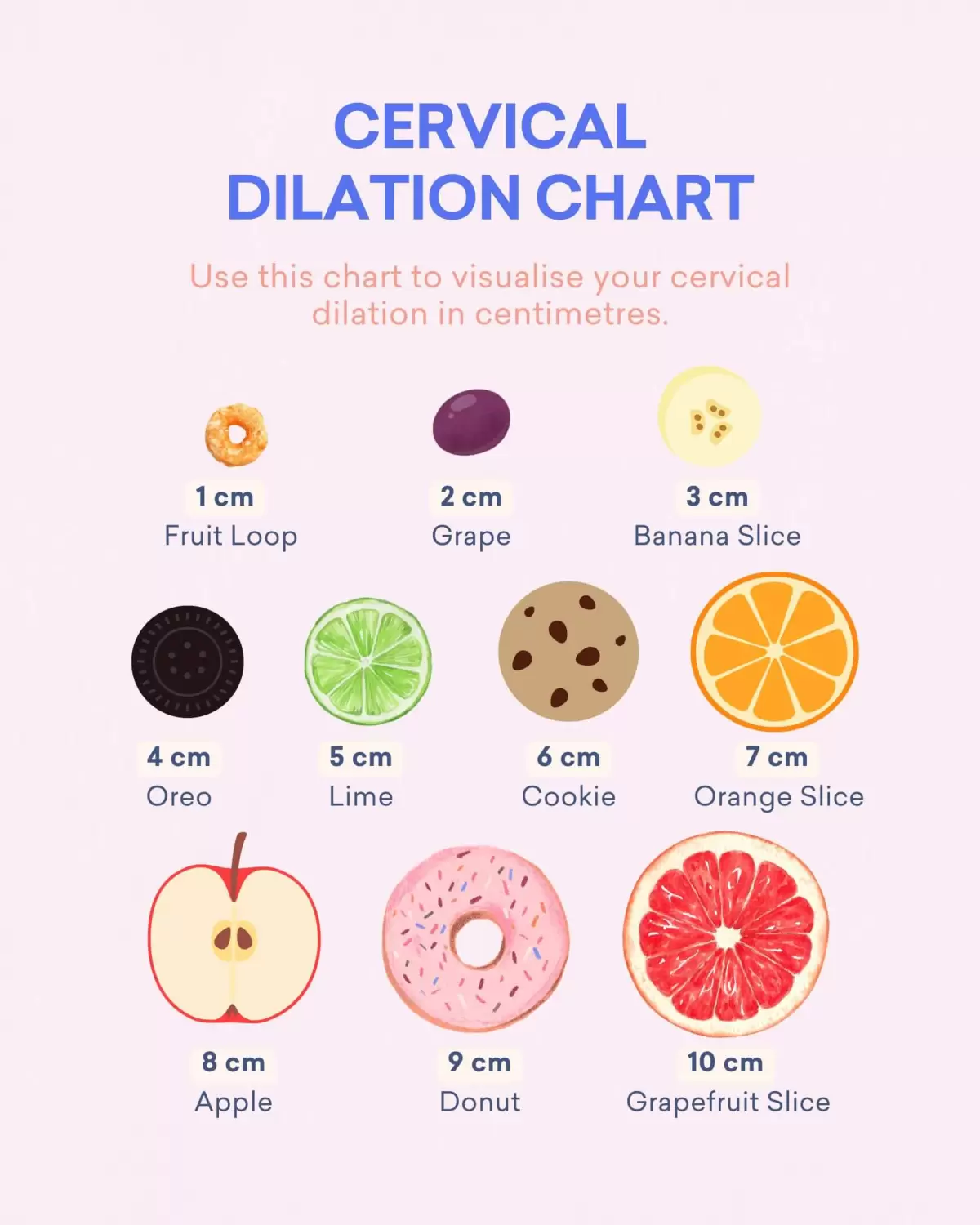
Cervical Dilation Chart: What to Expect from 1cm to 10cm
Your cervix starts closed and gradually dilates to 10cm during labor - that’s the magic number when it’s time to start pushing. This cervical dilation chart helps visualise what’s happening at each stage.
1 cm - Fruit Loop: Early signs - your cervix is just starting to open.
2 cm - Grape: You might not even know you’re in early labour yet.
3 cm - Banana Slice: Some early cramping and labour contractions could begin.
4 cm - Oreo: You’re likely in early labour and contractions may start to pick up.
5 cm - Lime Slice: Officially halfway! Things are becoming more active.
6 cm - Cookie: You’re in active labour now. Contractions are regular and intense.
7 cm - Orange Slice: Full steam ahead. You're getting closer to delivering your baby.
8 cm - Apple Slice: The transition phase begins. It’s the toughest but shortest part of labour.
9 cm - Donut: Almost there. The pressure is intense, but you’re nearly fully dilated.
10 cm - Grapefruit Slice: You’ve made it! Your cervix is dilated to 10 centimeters and it’s go-time. Your body is ready to push.

What Are the 3 Stages of Labour? (And Where Dilation Fits In)
Labour is typically broken down into three main stages, each marked by different levels of cervical dilation and contractions. From the early signs where your cervix begins to thin and open, to reaching full dilation at 10 centimetres — each stage plays a vital role in helping your baby move through the birth canal. Understanding how your cervix dilates and becomes 100% effaced can help you and your support team recognise when labour starts, when it’s time to head to the hospital, and when you’re ready to begin delivering your baby. Let’s break it down.
1. Early Labour (0-6cm)
This is the warm-up. Your cervix begins to thin and open (called effacement and dilation). You might feel period-like cramps or irregular contractions. It’s a great time to rest, eat something nourishing, and stay hydrated. Many women stay at home during this stage.
2. Active Labour + Transition (6-10cm)
This is when things ramp up. Cervical dilation progresses quickly. Contractions become longer, stronger, and closer together. You’ll likely head to the hospital or your birthing centre at this stage. You may feel emotional, tired, or even a bit overwhelmed - and that’s completely normal. Lean into your support system, trust your body, and breathe.
3. Delivery + Beyond
Once you're fully dilated to 10 centimeters and 100% effaced, the pushing begins. Your baby will move down the birth canal, and before you know it, you’ll be delivering your baby and meeting them for the first time. After the birth, there’s one more stage: delivering the placenta, usually within 30 minutes. Then? Rest, cuddles, and a whole lot of love.
Why Understanding Cervical Dilation Matters
Understanding what your body is doing — including how the cervix opens and thins — helps take away some of the fear and mystery around birth. Whether you’re planning a natural vaginal birth, preparing for an induction, or even exploring a C-section, knowing what’s happening behind the scenes — the phases of labour and checking your cervix (when medically advised) can be empowering.
Save this for later. Share it with your birth partner. Print it for your hospital bag. Because when it comes to birth, knowledge is power.
Want more real, relatable info like this?
Sign up for our newsletter, explore expert-led birth prep advice at our Baby Expo, or follow us on socials @onefinebaby
A cervix dilation chart is a visual guide that illustrates how the cervix gradually opens in preparation for childbirth. It typically shows the cervix expanding from closed (0 cm) to fully dilated (10 cm), which is when the body is ready for pushing. To make it easier to picture, the chart often compares each stage to common objects — like a Cheerio for 1 cm, a ping-pong ball for 3 cm, and a grapefruit for 10 cm — helping expectant parents understand what happens during labour.
Cervix dilation is one of the main ways doctors and midwives can tell how close you are to meeting your baby. As labour progresses, the cervix slowly softens and opens until it’s about 10 centimetres wide — just enough for your baby to move through the birth canal. Tracking this change helps your care team know how things are progressing and when it’s time to start pushing.
The time it takes to dilate from 1 centimetre to 10 centimetres can vary greatly from person to person. Early labour, when the cervix is opening slowly from 1 to around 4 centimetres, can take many hours or even longer for first-time mothers. Once active labour starts, usually around 4–6 centimetres, dilation tends to speed up. On average, first-time mums may take 6 to 12 hours or more to reach full dilation, while those who have given birth before often progress faster. Factors like the strength and frequency of contractions, the baby’s position, and individual differences all affect how quickly dilation occurs.
No, cervix dilation doesn’t happen at the same pace for every woman. Some may progress steadily, while others experience slow periods or sudden bursts of dilation. Factors like whether it’s a first pregnancy, the baby’s position, the strength of contractions, and individual anatomy all play a role. While guidelines suggest about 1 centimetre per hour during active labour, many women may dilate faster or slower, and each labour experience is unique.
You can support natural cervical dilation by keeping your body relaxed and mobile. Light activity like walking, rocking on a birthing ball, or changing positions can encourage the baby to move into an optimal position. Breathing exercises, gentle stretches, or a warm shower can also help ease tension and allow your body to progress more comfortably. Always discuss any techniques with your healthcare provider to make sure they are safe for your individual situation.